By continuing to use our site, you consent to the processing of cookies, user data (location information, type and version of the OS, the type and version of the browser, the type of device and the resolution of its screen, the source of where the user came from, from which site or for what advertisement, language OS and Browser, which pages are opened and to which buttons the user presses, ip-address) for the purpose of site functioning, retargeting and statistical surveys and reviews. If you do not want your data to be processed, please leave the site.
The Voice of People With Breast Cancer

Information
Living with Breast Cancer
Daily Life and Practical Matters
Older Adults
In Canada, people diagnosed with breast cancer at age 65 or older are often considered older adults. The risk of breast cancer increases with age. Most cases are diagnosed in people over 50, and the average age at diagnosis is 62 years old.
How Age Affects Your Care
Your age might influence how breast cancer is treated, but it should not limit your options. Many people over 65 live with other health conditions and take several medications, which can affect how well cancer treatments work. Changes in the body with age may also impact how you tolerate treatment.
But age alone should not determine your care plan. What matters most is your overall health, personal goals, and quality of life.
Age Shouldn’t Limit Your Options
Some people over 70 may be offered fewer treatment options based only on their age. But research shows many older adults respond well to standard treatments. Your care should reflect your values and what matters most to you.
A Comprehensive Geriatric Assessment (CGA) can help your care team better understand your health and needs. A CGA looks at:
- How independent you are in daily life
- Other health conditions and medications
- Memory and thinking
- Mental health
- Nutrition
- Support from family or friends
This information helps create a care plan that fits your life. If you have not had a CGA, ask your doctor if one could help.
Making Informed Decisions
You are a key part of your care team. When making decisions about treatment, consider:
- Your overall health and any other medical conditions
- The type and stage of your breast cancer
- The possible benefits and side effects of treatment
- Your personal values and goals for quality of life
- The support available to you at home or in your community
You deserve clear information and enough time to make choices that feel right for you.
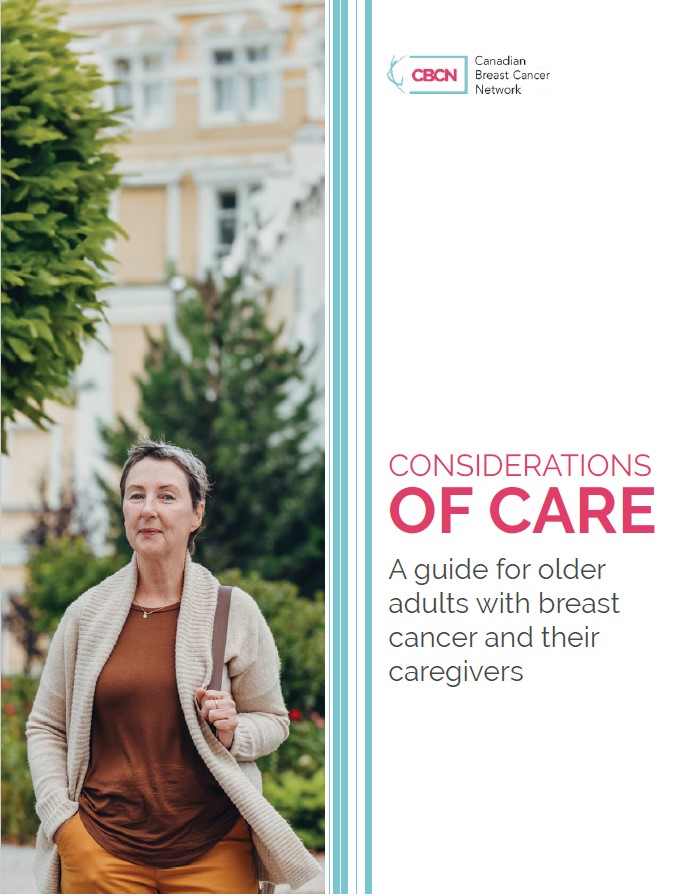 For more guidance, explore our guide, Considerations of Care: A Guide for Older Adults with Breast Cancer and Their Caregivers where we offer tips, checklists and resources to support your decisions.
Clinical Trials and Older Adults
Older adults are often underrepresented in clinical trials. This means there is less evidence about how treatments work in this age group. Including more aging adults in research will help improve care and create better, age-specific guidelines.
If you’re interested in joining a clinical trial, talk to your doctor or visit our Clinical Trials for Breast Cancer section.
Resources
- References
-
Abdel-Razeq, H., Abu Rous, F., Abuhijla, F., Abdel-Razeq, N., & Edaily, S. (2022). Breast cancer in geriatric patients: Current landscape and future prospects. Clinical Interventions In Aging, 17, 1445–1460. https://doi.org/10.2147/CIA.S365497
Advance Care Planning Canada. (2024). Advance care planning. https://www.advancecareplanning.ca/
Canadian Breast Cancer Network. (2024). Considerations of care: A guide for older adults with breast cancer and their caregivers. https://cbcn.ca/web/default/files/public/Reports/2025%20version%20Considerations%20of%20Care%20FINAL%20Digital.pdf
Canadian Cancer Statistics Advisory Committee. (2025). Canadian cancer statistics 2025. Canadian Cancer Society. https://cdn.cancer.ca/-/media/files/research/cancer-statistics/2025-statistics/2025_pdf_final_en.pdf
Kemeny, M. M., Peterson, B. L., Kornblith, A. B., Muss, H. B., Wheeler, J., Levine, E., Bartlett, N., Fleming, G., & Cohen, H. J. (2003). Barriers to clinical trial participation by older women with breast cancer. Journal of Clinical Oncology: Official Journal of the American Society of Clinical Oncology, 21(12), 2268–2275. https://doi.org/10.1200/JCO.2003.09.124
Le Saux, O., Ripamonti, B., Bruyas, A., Bonin, O., Freyer, G., Bonnefoy, M., & Falandry, C. (2015). Optimal management of breast cancer in the elderly patient: Current perspectives. Clinical Interventions In Aging, 10, 157–174. https://doi.org/10.2147/CIA.S50670
Parks, R. M., Lakshmanan, R., Winterbottom, L., Al Morgan, D., Cox, K., & Cheung, K. L. (2012). Comprehensive geriatric assessment for older women with early breast cancer - A systematic review of literature. World Journal of Surgical Oncology, 10, 88. https://doi.org/10.1186/1477-7819-10-88
Tesarova P. (2012). Breast cancer in the elderly-Should it be treated differently?. Reports of Practical Oncology and Radiotherapy: Journal of Greatpoland Cancer Center in Poznan and Polish Society of Radiation Oncology, 18(1), 26–33. https://doi.org/10.1016/j.rpor.2012.05.005
Turner, N., Zafarana, E., Sanna, G., Mottino, G., & Biganzoli, L. (2013). The best treatment for older patients with breast cancer. EJC Supplements : EJC : Official Journal of EORTC, European Organization for Research and Treatment of Cancer ... [et al.], 11(2), 299–300. https://doi.org/10.1016/j.ejcsup.2013.07.056
The Canadian Cancer Society has a database that can be used to find local support services in your area. You can access it below:
SHARE

Our Stories

Events
 Receive updates by email Subscribe Now
About CBCN
CBCN strives to voice the views and concerns of breast cancer patients through education, advocacy activities, and the promotion of information sharing.
Canadian Breast Cancer Network
Mailing Address: M013 - 1367 Clyde Ave. Ottawa, ON K2G 3H7
Tel: 613-230-3044
Toll-free: 1-800-685-8820
Email Us


