

By Adriana Ermter
In our bi-monthly column, senior writer and editor Adriana Ermter shares her personal experiences with breast cancer
My friend has breast cancer.
We’ve been friends for two decades. She’s fun and laughs easily. A head-turner with model-like beauty who, I don’t think, knows how stunning she is. She’s a fantastic mom to her two kids. They’re her forever priority. Her energy with them, and for life, is impressive. She can even stay out (and awake!) until the wee hours of the morning, dancing at an electronic dance music concert. And her taste in everything from fashion and art to home décor, travel spots and hosting a dinner party is and has always been impeccable. I don’t know anyone else like her.
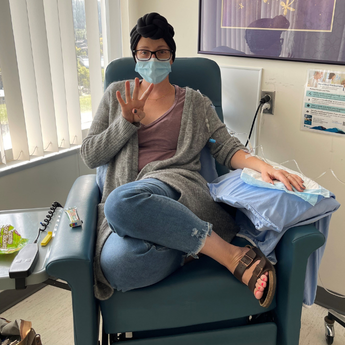
My friend is still all those things, although lately, she listens to her favourite DJs’ music on her smartphone, not live. Her family vacations have been replaced with doctor’s visits and rounds of chemo. She's halfway through her chemo treatment, yet unsure if she’ll ring the bell at the end. Surgery and radiation remain a question mark, but are most likely to come. Most days my friend is positive. At least outwardly. Let’s face it, no one really knows how another woman feels going through this. I know that part too well.
My friend reminds me of me. It’s uncomfortable to be on this side of cancer. I don’t like watching someone I love enter that world and it has surfaced more emotions than I anticipated. The first being fear. For her and for me.
I feel extremely selfish writing this. Like I’m an asshole to think of myself. Yet, my worry for my friend and the reality of her diagnosis have somehow, along the way, reignited not only the memories of my breast cancer experience, but also my fear of cancer recurrence (FCR). It has also unleashed my survivor’s guilt. All of this has taken me by surprise. I thought I was over this, past it, healed even. I mean, come on! I’ve been healthy and cancer-free for more than seven years now. And still, it’s all come surging back.
Why FCR and Survivor’s Guilt Perpetuate
Fear of cancer recurrence is widely recognized as a common concern among people diagnosed with cancer and one of their most common unmet needs. In a 2022 research study involving more than 9,000 cancer survivors, researchers found that nearly 59 per cent had clinically significant levels of FCR and nearly one in five had very high levels. FCR can persist years after diagnosis and does not necessarily correspond to an individual’s actual risk of recurrence. Anything can act as a reminder: a doctor’s appointment, the language used around cancer, waiting for mammogram results, a friend’s diagnosis…anything, all of it, when you least expect it.
On top of that, the National Cancer Institute notes that people can experience increased vulnerability, anxiety about recurrence and even physical responses to all types of reminders associated with treatment, including survivor’s guilt.
Research on survivor’s guilt in cancer is limited and it would be misleading to suggest that there is a single prevalence figure for people diagnosed with breast cancer. But oncology social-work research, published in journals like Social Work in Health Care, along with organizations like the Quebec Breast Cancer Foundation have identified guilt, helplessness, grief and questions about why one person survives while another suffers as important survivorship experiences. These feelings can also work in our favour, giving us a particular kind of understanding. Think about it. Who else understands a breast cancer diagnosis, treatment and life afterwards better than us? Still, how we go about being supportive is important.
What Helpful Peer Support Looks Like
No one likes a one-upper and that’s not what this kind of peer support is all about. Rather, it’s about sharing insight, like which brand of cream to use during radiation, which underwire bra feels most comfortable post-treatment and surgery, and how to squish an extra-long pillow against your body to sleep better at night. But I only talk about these experiences and share this information with my friend when she asks. I also don’t and can't tell her what will happen to her. I listen. A lot. I do not compare or turn her experience into a replay of mine. I only answer questions when she wants answers. I believe this distinction matters.
Research supports the value of this kind of peer support. Talking to others living with breast cancer helps people feel less anxious and more supported, though experts caution that current research is still too weak to prove it works for everyone. A fresh look at 14 past studies, however, shows that peer groups can boost everyday happiness and calm nerves.
It’s also important to remember that not every breast cancer experience looks the same, despite the Canadian Cancer Society estimating that 32,400 women will be diagnosed with breast cancer by the end of this year (along with about 300 men). Because even with numbers this high (89 women are diagnosed daily), everyone’s experience is unique. Statistics describe populations; they do not predict an individual's future.
Other Ways To Support Each Other
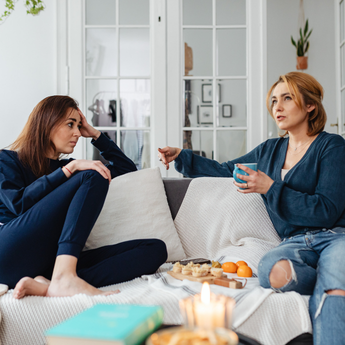
For me, this starts with staying in my own lane. I don't assume that because I handled something one way, my friend should too. I try to be present, take myself out of the equation and simply ask: “What do you need from me right now?” Sometimes the answer is information. Other times, it’s a distraction, like telling her a funny story about a date I had with a guy I met on Hinge that ended with a high-five because I couldn’t bear the idea of a hug—and having his Brut cologne sticking to my clothes. Now and then, it’s a homemade dinner delivered to the door or just sitting together without talking about cancer at all.
And sometimes I need support, too. I know, the selfish part again.
But that’s cancer life and it’s not smooth and straightforward. So, when I feel insecure, unsure, scared, you name it, I go online and log onto CBCN's Community and Support pages, where I have options like peer-led support groups and professionally led counselling. I also reach out to one of my besties, who had breast cancer one year before me and is my touchpoint on reality, hope and the mindfuck that is this disease. She makes me feel normal and seen. I love her, even if we go through months without seeing each other. She’s who I hope I can be one day for my friend who’s going through cancer now.
My friend’s diagnosis has changed something for me. Not my history or future and not hers. It has simply reminded me that survivorship isn't a clean line you cross when treatment ends.
Adriana Ermter is a multi award-winning writer and editor. Her work can be read in FASHION, IN Magazine, 29Secrets.com, RethinkBreastCancer.ca and AmongMen.com. The former Beauty Director for FASHION and Editor-in-Chief for Salon and Childview magazines lives in Toronto with her two very spoiled rescue cats, Murphy and Olive. You can follow Adriana on Instagram @AdrianaErmter
 Receive updates by email

