

Many aspects of healthcare access in Canada are based on where you live. Access to genetic testing for hereditary cancer is no exception. To assess and illustrate this, we reached out to our community and spoke to five women to map where they would and would not be eligible to access genetic testing in Canada in the present day.
We asked these women about their personal and family health history based on the genetic testing eligibility criteria of provinces and territories (PTs) that had this information online and publicly available. In focusing on just public information that is online, we recognize that our findings are based only on this information. In other words, a PT might have eligibility criteria that can be gotten from a genetic counsellor but not posted online. We choose to focus on just online information because many people get their health information online and we wanted to reflect what individuals can find out about their own access.
Specifically, Manitoba, Newfoundland and Labrador, Northwest Territories, Nunavut, and Saskatchewan do not have publicly available information online on how a person may be eligible to access hereditary cancer genetic testing. Therefore, this series comments only on eligibility access in Alberta, British Columbia, New Brunswick, Nova Scotia, Ontario, Prince Edward Island, Quebec and Yukon.
It is also important to note that Yukon Territories uses the same eligibility criteria as British Columbia, while New Brunswick, Nova Scotia, and Prince Edward Island share the same eligibility criteria.
Let’s meet Colleen Foran and explore where she may or may not be eligible to access genetic testing for hereditary cancer in Canada.
About Colleen Foran
Colleen was 55 years old in 2010 when she was in the process of moving from Alberta to Vancouver, BC. Concerned she may not be able to find a doctor in Vancouver, Colleen decided to have a full workup done before she moved. Part of the workup involved a mammogram which showed a small mass in her left breastColleen met with her general practitioner to discuss the results of a second, follow-up mammogram the morning she was leaving to drive to Vancouver. In order to follow up on her results in Vancouver, Colleen had to negotiate a new health care system since she wasn’t eligible yet to directly access the BC Cancer Agency.
She was eventually diagnosed with stage II breast cancer. To her knowledge, no one else in her family had had breast cancer, and she was completely unprepared. Colleen’s paternal aunt and father had both died from colon cancer and her grandmother had died from a cancer, but it was unknown if it was breast cancer. She underwent two surgeries, a lumpectomy, and a second surgery to remove lymph nodes in her left armpit. Following her surgeries, she had two sets of chemotherapy, 16 sessions of radiation, and was prescribed Tamoxifen for over 5 years.
After several years of no recurrence, Colleen was diagnosed with metastatic breast cancer in June 2019. She began taking capecitabine, a chemotherapy treatment, after unsuccessfully trying the targeted therapy of ribociclib and letrozole. Colleen is now approaching the 7-year anniversary of her metastatic diagnosis.
In Colleen’s Own Words
“My family is quite small, or the family that I am aware of are few. My mother was an only child, and my father had one sister who had one daughter. No one, including myself, has had genetic testing to my knowledge. To date, I have not accessed genetic testing. I was not informed of the possibility of genetic testing when I was diagnosed with my first, stage II cancer in 2010, nor when I was diagnosed with metastatic cancer in 2019. At a recent appointment with my Nurse Practitioner, she noted that I have record of being HER2- at one point in my file and HER2-low+ at another which makes it unclear if I qualify for genetic testing through BC Cancer.”
Where Is Colleen Eligible to Access Hereditary Cancer Genetic Testing in Canada?
Based on publicly available information on the eligibility criteria to access genetic testing for hereditary breast cancer, Colleen is eligible to access testing in British Columbia and Yukon.
British Columbia and Yukon
While Colleen does meet one family history criterion, that of having multiple close relatives on the same side of the family with the same type(s) of cancer (her father and paternal aunt having colon cancer), BC and Yukon require that two of the family history factors are met.
However, Colleen meets one of the personal health history criteria, that of having unusual polyps or more polyps than expected following a colonoscopy. This makes Colleen eligible to access genetic testing in British Columbia and Yukon based on her personal health history.
Where Is Colleen Not Eligible to Access Hereditary Cancer Genetic Testing in Canada?
Based on publicly available information on the eligibility criteria to access genetic testing for hereditary breast cancer, Colleen is not eligible to access testing in Alberta, New Brunswick, Nova Scotia, Prince Edward Island, Ontario, or Quebec as she does not meet any of their personal or family health history criteria.
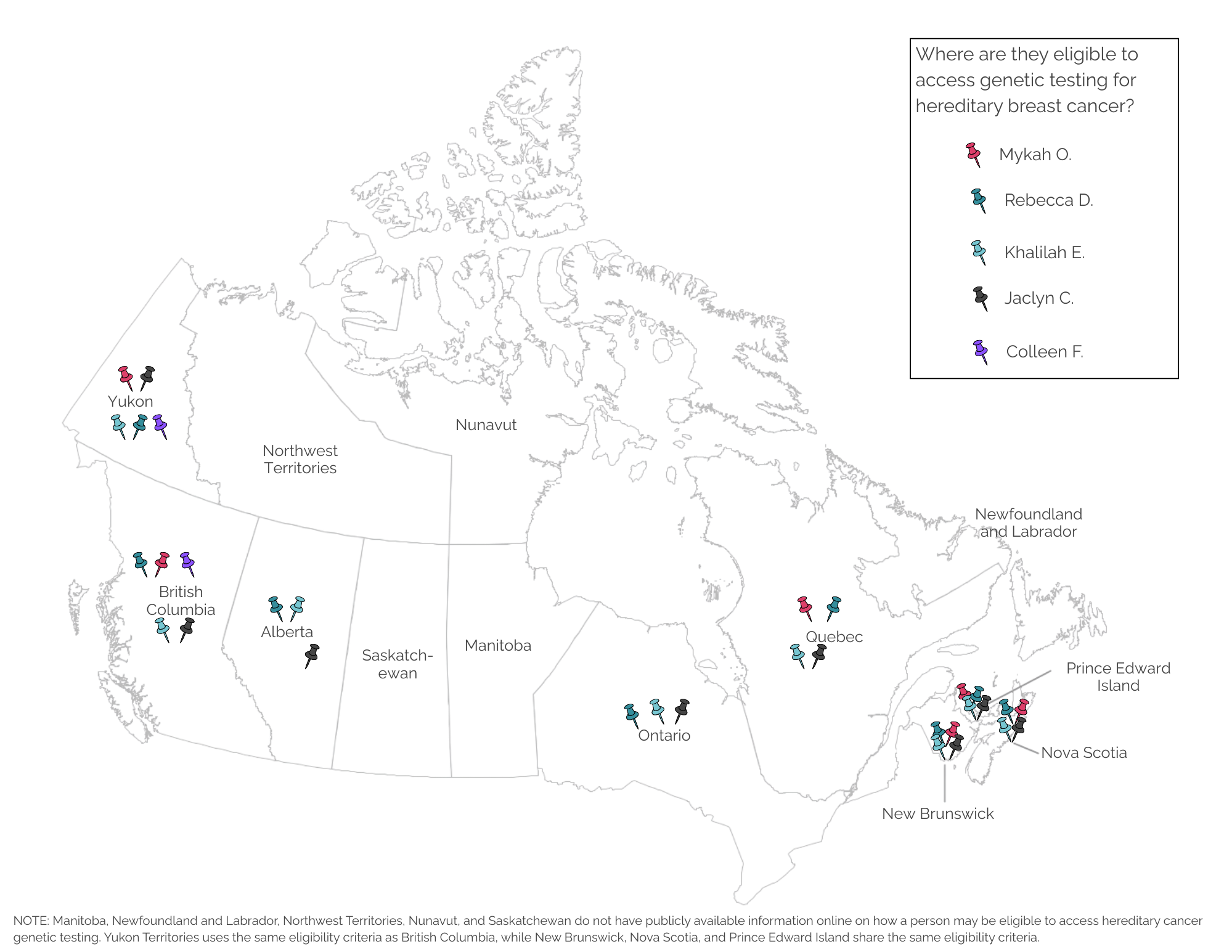
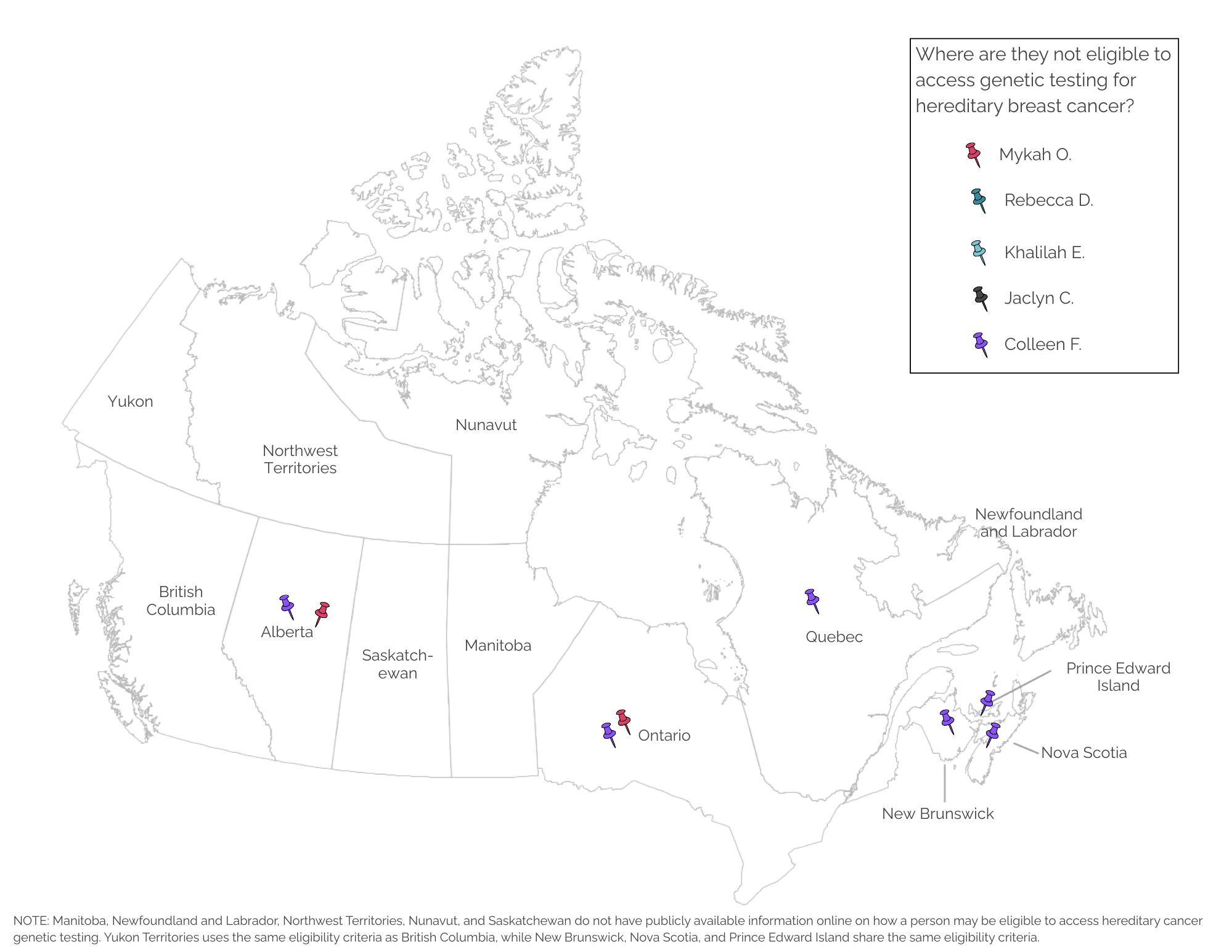
In this blog series, we see just how much access to healthcare in Canada can be determined simply because of where a person lives. Canada needs eligibility criteria that are the same across the country. Individuals concerned about hereditary cancer and people diagnosed with breast cancer cannot be at the mercy of their postal code determining their health and access to adequate healthcare.
Not only should access to genetic testing be the same across Canada, but it should also be updated to ensure it reflects our latest knowledge of hereditary breast cancer and gene mutations. Sources like the Canadian Recommendations for Germline Genetic Testing of Patients with Breast Cancer: A Call to Action should be consulted to develop standardized, inclusive, guidelines that don't let people fall through the cracks.
In Colleen’s case, it is possible that her breast cancer diagnosis is not associated with hereditary breast cancer. However, since her family is small and the health history of past family members is not known, it is possible that Colleen could have other eligibility criteria that she is unaware of. This shows the importance of creating inclusive testing guidelines. The Canadian Recommendations for Germline Genetic Testing of Patients with Breast Cancer: A Call to Action stresses the importance of developing guidelines that account both for personal and family health history, as well as the potential for testing to inform treatment options.
Tied in with this is the importance of testing a large number of gene mutations that have been associated with breast cancer, not just the BRCA1 and BRCA2 gene mutations. Tests that analyze beyond BRCA1 and 2 mutations should also be standard, so that individuals have a wider picture of their health. Since results can have such a huge impact on a treatment plan, nobody should be forced to pay out-of-pocket to see if they do or do not have hereditary breast cancer. Once more comprehensive guidelines for genetic testing have been developed, the eligibility to access genetic testing should be posted online and made publicly available by all provinces and territories.
Additionally, where the five women we spoke to may or may not be able to actually access genetic testing is just for illustrative purposes. We only show where they meet the eligibility criteria that has been set and made publicly available by each PT. It does not reflect their actual access to genetic testing for hereditary cancer as there may be further access criteria. For example, in some places a person can get genetic testing automatically if they meet the criteria, while in others, a referral from a doctor might be needed. This was shown in Mykah’s case where she does not meet the eligibility criteria in Alberta, where she lives, but was still able to get tested, although with a lot of bumps along the way.



 Receive updates by email

